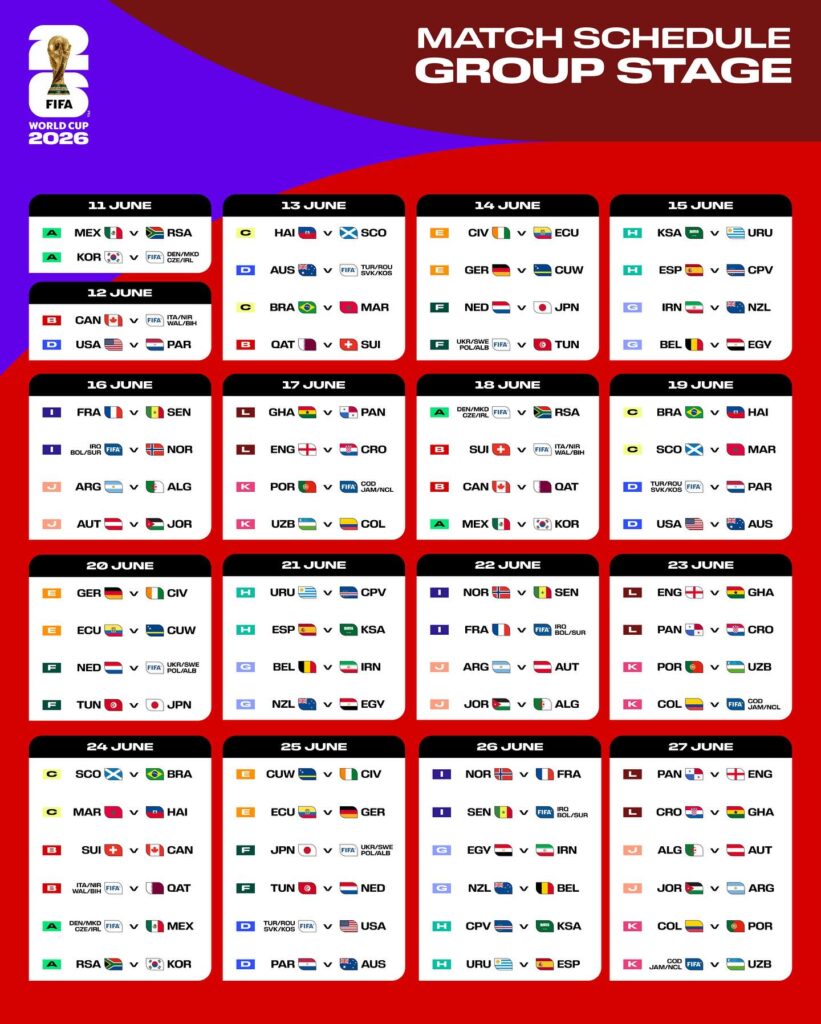
La Copa Mundial de la FIFA 2026 dio un paso histórico el fin de semana del 6 de diciembre tras la realización del sorteo oficial en el Kennedy Center de Washington, D.C., donde quedaron definidos los 12 grupos que conformarán la primera edición con 48 selecciones participantes. El torneo, que será organizado conjuntamente por Estados Unidos, México y Canadá, promete ser el más grande y diverso en la historia del fútbol.
Un formato renovado y expansión histórica
Por primera vez, el Mundial incluirá 48 equipos distribuidos en 12 grupos de cuatro selecciones. Avanzarán a la fase de eliminación directa los dos primeros de cada grupo, además de los mejores terceros según desempeño. En total se disputarán 104 partidos, una cifra récord para la competición.
La ampliación del formato permitirá la participación de nuevas naciones y brindará un escenario más amplio para la competencia internacional.
Así quedaron conformados los grupos
Los 12 grupos quedaron definidos de la siguiente manera, con algunas plazas aún pendientes de los repechajes internacionales:
Grupo A: México, Sudáfrica, Corea del Sur, ganador del Play-off UEFA D.
Grupo B: Canadá, Suiza, Catar, ganador del Play-off UEFA A.
Grupo C: Brasil, Marruecos, Escocia, Haití.
Grupo D: Estados Unidos, Australia, Paraguay, ganador del Play-off UEFA C.
Grupo E: Alemania, Ecuador, Costa de Marfil, Curazao.
Grupo F: Países Bajos, Japón, Túnez, ganador del Play-off UEFA B.
Grupo G: Bélgica, Egipto, Irán, Nueva Zelanda.
Grupo H: España, Uruguay, Arabia Saudita, Cabo Verde.
Grupo I: Francia, Senegal, Noruega, ganador del Play-off internacional.
Grupo J: Argentina, Austria, Argelia, Jordania.
Grupo K: Portugal, Colombia, Uzbekistán, ganador del Play-off internacional 1.
Grupo L: Inglaterra, Croacia, Panamá, Ghana.
En total, seis cupos siguen en disputa y se definirán en marzo de 2026 a través de los repechajes intercontinentales y europeos.
Grupos más competitivos y posibles “grupos de la muerte”:
El sorteo dejó varios grupos con alto nivel competitivo. Analistas deportivos destacan como grupos especialmente difíciles los siguientes:
Grupo F (Países Bajos, Japón, Túnez + Play-off), por el estilo ofensivo de neerlandeses y japoneses.
Grupo D (Estados Unidos, Australia, Paraguay + Play-off), con selecciones de gran físico y táctica equilibrada.
Grupo B (Canadá, Suiza, Catar + Play-off), donde el cuadro europeo y el local canadiense parten como favoritos.
Otros grupos, como el C (Brasil, Marruecos, Escocia, Haití) o el J (Argentina, Austria, Argelia, Jordania), también podrían ofrecer duelos históricos y sorpresas debido al impulso reciente de varias selecciones.
Sedes y estructura del torneo
El Mundial 2026 se jugará en tres países:
Estados Unidos albergará la mayoría de los partidos, distribuidos en estadios de ciudades como Los Ángeles, Miami, Nueva York, Dallas, Atlanta, Seattle, Houston y Kansas City.
México será sede en Ciudad de México, Guadalajara y Monterrey.
Canadá recibirá encuentros en Toronto y Vancouver.
El torneo se inaugurará el 11 de junio de 2026, y el calendario oficial de partidos —incluyendo fechas, horarios y sedes específicas para cada grupo— será publicado una vez se confirmen las últimas selecciones clasificadas.
Expectativa global rumbo al 2026
Con su formato ampliado, mayor participación y tres países anfitriones, la Copa Mundial de 2026 se perfila como uno de los eventos deportivos más importantes de la década. La variedad de estilos de juego, la inclusión de más naciones y la escala sin precedentes del evento han generado entusiasmo entre aficionados y expertos de todo el mundo.
En los próximos meses, la FIFA seguirá publicando detalles sobre la venta de entradas, la logística, el transporte y el calendario final de partidos, mientras las selecciones nacionales se preparan para una Copa Mundial que se espera marque un nuevo hito en la historia del fútbol. Si desea comprar entradas, debe registrarse en Fifa.com para participar en el sorteo y tener la oportunidad de adquirirlas. El plazo de inscripción es del 11 de diciembre al 13 de enero.
World Cup 2026 Groups Revealed: All the Key Updates from the Official Draw
The 2026 FIFA World Cup took a historic step forward on the weekend of December 6th with the official draw at the Kennedy Center in Washington, D.C., which determined the 12 groups that will make up the first edition with 48 participating teams. The tournament, which will be co-hosted by the United States, Mexico, and Canada, promises to be the biggest and most diverse in football history.
A historic expansion and a new competition format
For the first time, the World Cup will include 48 teams divided into 12 groups of four. The top two teams from each group will advance to the knockout stage, along with the best-performing third-place teams, for a total of 104 matches — the highest number ever played in the competition.
This expanded format opens the door for new nations to participate and brings greater global representation to the sport’s biggest stage.
Official group breakdown
The 12 groups were drawn as follows, with several spots still pending due to upcoming playoff matches:
Group A: Mexico, South Africa, South Korea, Winner of UEFA Playoff D
Group B: Canada, Switzerland, Qatar, Winner of UEFA Playoff A
Group C: Brazil, Morocco, Scotland, Haiti
Group D: United States, Australia, Paraguay, Winner of UEFA Playoff C
Group E: Germany, Ecuador, Ivory Coast, Curaçao
Group F: Netherlands, Japan, Tunisia, Winner of UEFA Playoff B
Group G: Belgium, Egypt, Iran, New Zealand
Group H: Spain, Uruguay, Saudi Arabia, Cape Verde
Group I: France, Senegal, Norway, Winner of International Playoff
Group J: Argentina, Austria, Algeria, Jordan
Group K: Portugal, Colombia, Uzbekistan, Winner of International Playoff 1
Group L: England, Croatia, Panama, Ghana
Six remaining spots will be filled in March 2026 through intercontinental and UEFA playoffs.
High-stakes groups and potential “Groups of Death”:
The draw produced several highly competitive groups. Sports analysts highlight the following as particularly challenging:
Group F (Netherlands, Japan, Tunisia + Playoff), featuring dynamic and fast-paced teams.
Group D (USA, Australia, Paraguay + Playoff), known for physical and tactically balanced matchups.
Group B (Canada, Switzerland, Qatar + Playoff), where the European side and host Canada lead the predictions.
Other groups, such as Group C (Brazil, Morocco, Scotland, Haiti) and Group J (Argentina, Austria, Algeria, Jordan), are also expected to deliver memorable clashes and possible surprises.
Host cities and tournament structure
The 2026 World Cup will be hosted across three nations:
United States, which will host the majority of matches in cities such as Los Angeles, Miami, New York, Dallas, Atlanta, Seattle, Houston, and Kansas City.
Mexico, with matches in Mexico City, Guadalajara, and Monterrey.
Canada, which will welcome games in Toronto and Vancouver.
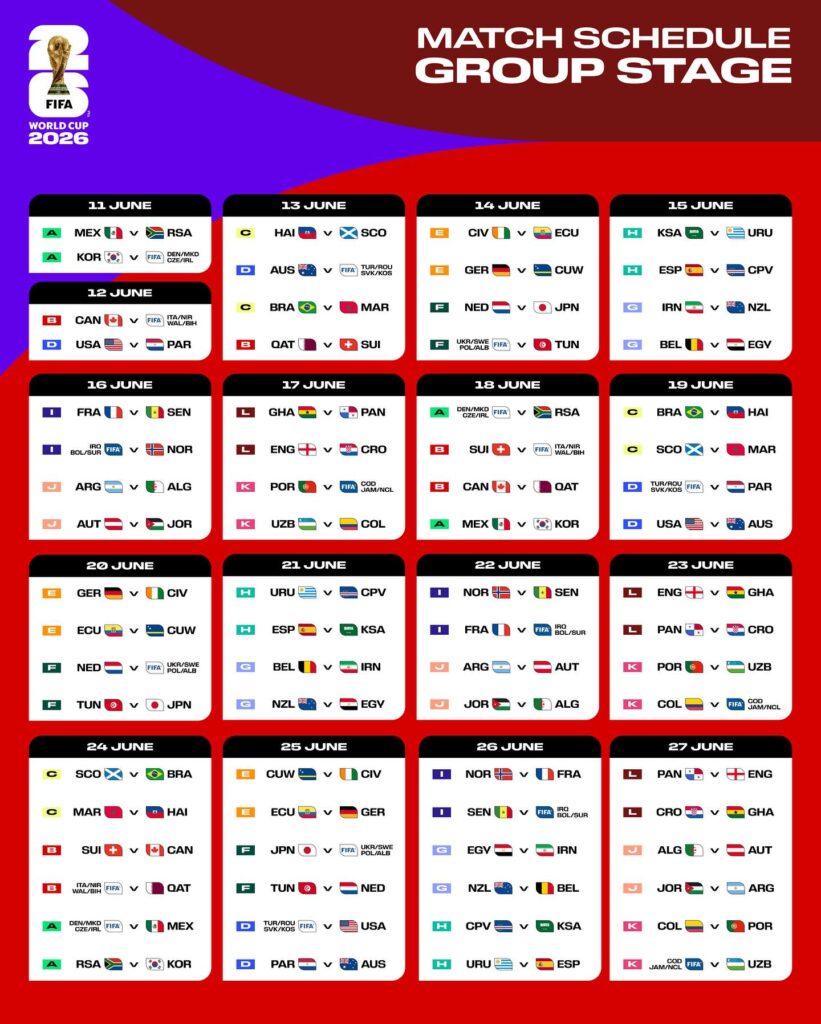
The tournament kicks off on June 11, 2026, and the full match schedule — including dates, venues, and kickoff times — will be released once the final playoff positions are confirmed.
Global excitement builds toward 2026
With its expanded format, broader participation, and three host countries, the 2026 World Cup is shaping up to be one of the most significant sporting events of the decade. The variety of playing styles, the inclusion of more nations, and the unprecedented scale of the event have generated excitement among fans and experts worldwide.In the coming months, FIFA will continue releasing details on ticketing, logistics, transportation, and the final match calendar as national teams prepare for a World Cup that is expected to set a new benchmark in football history. If you would like to purchase tickets you must register on Fifa.com to enter the drawing to win the chance to purchase tickets. The registration window is December 11 – January 13.